|
|
 |
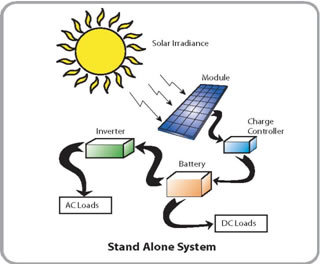
STANDALONES Systems
A stand alone system is a non-hybrid PV power system that is independent
of the utility grid or any other power source. The systems operate
reliably and are the best option for many remote applications around
the world. Some requirements for obtaining long term performance
from system include:
- Developing and following a complete operation and maintenance
plan
- Consistent sizing calculations
- Knowledge of hardware availability and performance
- Use of good engineering practices when installing the system
PV power systems have several attributes which are quite unique
compared to other power systems, and call for very different system
design procedures. Following are some issues that must be considered:
- Cost - For many applications, the advantages of PV systems offset
their relatively high initial cost.
- Efficiency - All components between the PV array and the load
must be highly efficient, and each component’s characteristics
must be considered when sizing the system.
- Modularity - A PV system can be designed for easy expansion.
- Reliability -With no moving parts, a PV array is a uniquely
reliable energy source, and the system designer must select system
components which do not compromise that reliability.
- Maintenance - Since most PV systems operate at remote, unattended
sites, they must be designed for minimum maintenance, typically
at six-month or one-year intervals .
- Power Quality -The quality of the delivered power -frequency,
ripple, voltage regulation, and harmonic distortion - must be
within the load's tolerance.
- Environment - PV systems create no pollution and generate no
waste products.
|