 |
 |
 |
|
 |
|
Buynigeriaonline.com |
| |
Home | | |
Contact us | | |
About us | | |
Trade Leads | | |
Services | | |
Faq |
|
|
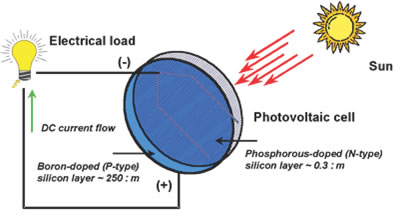
Photovoltaic Fundamentals Current PV Technology Photovoltaics (PV) or solar cells as they are often referred to, are semiconductor devices that convert sunlight into direct current (DC) electricity. Groups of PV cells are electrically configured into modules and arrays, which can be used to charge batteries, operate motors, and to power any number of electrical loads. With the appropriate power conversion equipment, PV systems can produce alternating current (AC) compatible with any conventional appliances, and operate in parallel with and interconnected to the utility grid. History of Photovoltaics The first conventional photovoltaic cells were produced in the late 1950s, and throughout the 1960s were principally used to provide electrical power for earth-orbiting satellites. In the 1970s, improvements in manufacturing, performance and quality of PV modules helped to reduce costs and opened up a number of opportunities for powering remote terrestrial applications, including battery charging for navigational aids, signals, telecommunications equipment and other critical, low power needs. In the 1980s, photovoltaics became a popular power source for consumer electronic devices, including calculators, watches, radios, lanterns and other small battery charging applications. Following the energy crises of the 1970s, significant efforts also began to develop PV power systems for residential and commercial uses both forstand-alone, remote power as well as for utility-connected applications. During the same period, international applications for PV systems to power rural health clinics, refrigeration, water pumping, telecommunications, and off-grid households increased dramatically, and remain a major portion of the present world market for PV products. Today, the industry’s production of PV modules is growing at approximately 25 percent annually, and major programs in the U.S., Japan and Europe are rapidly accelerating the implementation of PV systems on buildings and interconnection to utility networks. How PV Cells Work A typical silicon PV cell is composed of a thin wafer consisting of an ultra-thin layer ofphosphorus-doped (N-type) silicon on top of a thicker layer of boron-doped (P-type) silicon. An electrical field is created near the top surface of the cell where these two materials are in contact, called the P-N junction. When sunlight strikes the surface of a PV cell, this electrical field provides momentum and direction to light-stimulated electrons, resulting in a flow of current when the solar cell is connected to an electrical load
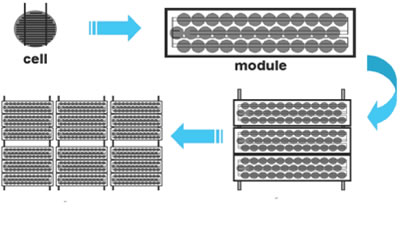
Figure 1. Diagram of photovoltaic cell. Regardless of size, a typical silicon PV cell produces about 0.5 – 0.6 volt DC under open-circuit, no-load conditions. The current (and power) output of a PV cell dependson its efficiency and size (surface area), and is proportional the intensity of sunlight striking the surface of the cell. For example, under peak sunlight conditions a typical commercial PV cell with a surface area of 160 cm^2 (~25 in^2) will produce about 2 watts peak power. If the sunlight intensity were 40 percent of peak, this cell would produce about 0.8 watts. PV Cells, Modules, & Arrays Photovoltaic cells are connected electrically in series and/or parallel circuits to produce higher voltages, currents and power levels. Photovoltaic modules consist of PV cell circuits sealed in an environmentally protective laminate, and are the fundamental building block of PV systems. Photovoltaic panels include one or more PV modules assembled as a pre-wired, field-installable unit. A photovoltaic array is the complete power-generating unit, consisting of any number of PV modules and panels.
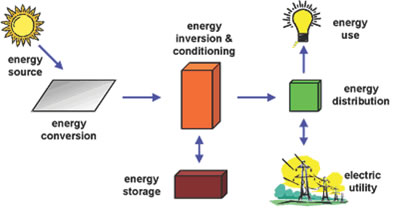
Figure 2. Photovoltaic cells, modules, panels and arrays. The performance of PV modules and arrays are generally rated according to their maximum DC power output (watts) under Standard Test Conditions (STC). Standard Test Conditions are defined by a module (cell) operating temperature of 25o C (77 F), and incident solar irradiance level of 1000 W/m2 and under Air Mass 1.5 spectral distribution. Since these conditions are not always typical of how PV modules and arrays operate in the field, actual performance is usually 85 to 90 percent of the STC rating. Today’s photovoltaic modules are extremely safe and reliable products, with minimal failure rates and projected service lifetimes of 20 to 30 years. Most major manufacturers offer warranties of twenty or more years for maintaining a high percentage of initial rated power output. When selecting PV modules, look for the product listing (UL), qualification testing and warranty information in the module manufacturer’s specifications. How a PV System Works Simply put, PV systems are like any other electrical power generating systems, just the equipment used is different than that used for conventional electromechanical generating systems. However, the principles of operation and interfacing with other electrical systems remain the same, and are guided by a well-established body of electrical codes and standards. Although a PV array produces power when exposed to sunlight, a number of other components are required to properly conduct, control, convert, distribute, and store the energy produced by the array. Depending on the functional and operational requirements of the system, the specific components required, and may include major components such as a DC-AC power inverter, battery bank, system and battery controller, auxiliary energy sources and sometimes the specified electrical load (appliances). In addition, an assortment of balance of system (BOS) hardware, including wiring, overcurrent, surge protection and disconnect devices, and other power processing equipment. Figure 3 show a basic diagram of a photovoltaic system and the relationship of individual components.
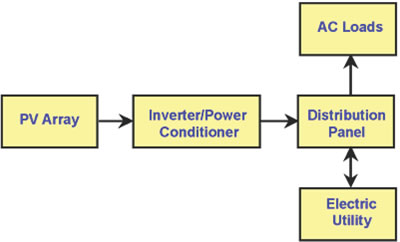
Figure 3. Major photovoltaic system components. Why Are Batteries Used in Some PV Systems? Batteries are often used in PV systems for the purpose of storing energy produced bythe PV array during the day, and to supply it to electrical loads as needed (during thenight and periods of cloudy weather). Other reasons batteries are used in PV systems are to operate the PV array near its maximum power point, to power electrical loads at stable voltages, and to supply surge currents to electrical loads and inverters. In most cases, a battery charge controller is used in these systems to protect the battery from overcharge and overdischarge (Figure 6). Types of PV Systems How Are Photovoltaic Systems Classified? Photovoltaic power systems are generally classified according to their functional and operational requirements, their component configurations, and how the equipment is connected to other power sources and electrical loads. The two principle classifications are grid-connected or utility-interactive systems and stand-alone systems. Photovoltaic systems can be designed to provide DC and/or AC power service, can operate interconnected with or independent of the utility grid, and can be connected with other energy sources and energy storage systems.1.7.1 Grid-Connected (Utility-Interactive) PV Systems. Grid-connected or utility-interactive PV systems are designed to operate in parallel with and interconnected with the electric utility grid. The primary component in grid-connected PV systems is the inverter, or power conditioning unit (PCU). The PCU converts the DC power produced by the PV array into AC power consistent with the voltage and power quality requirements of the utility grid, and automatically stops supplying power to the grid when the utility grid is not energized. A bi-directional interface is made between the PV system AC output circuits and the electric utility network, typically at an on-site distribution panel or service entrance. This allows the AC power produced by the PV system to either supply on-site electrical loads, or to back feed the grid when the PV system output is greater than the on-site load demand. At night and during other periods when the electrical loads are greater than the PV system output, the balance of power required by the loads is received from the electric utility This safety feature is required in all grid-connected PV systems, and ensures that the PV system will not continue to operate and feed back onto the utility grid when the grid is down for service or repair
Figure 4. Diagram of grid-connected
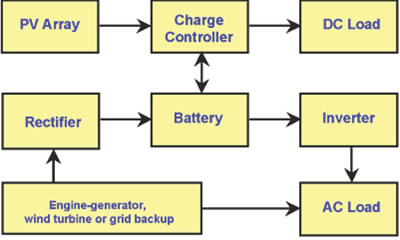
photovoltaic system. Stand-Alone Photovoltaic Systems Stand-alone PV systems are designed to operate independent of the electric utility grid, and are generally designed and sized to supply certain DC and/or AC electrical loads. These types of systems may be powered by a PV array only, or may use wind, an engine-generator or utility power as an auxiliary power source in what is called a PV-hybrid system. The simplest type of stand-alone PV system is a direct-coupled system, where the DC output of a PV module or array is directly connected to a DC load (Figure 5). Since there is no electrical energy storage (batteries) in direct-coupled systems, the load only operates during sunlight hours, making these designs suitable for common applications such as ventilation fans, water pumps, and small circulation pumps for solar thermal water heating systems. Matching the impedance of the electrical load to the maximum power output of the PV array is a critical part of designing well-performing direct-coupled system. For certain loads such as positive-displacement water pumps, a type of electronic DC-DC converter, called a maximum power point tracker (MPPT) is used between the array and load to help better utilize the available array maximum power output.
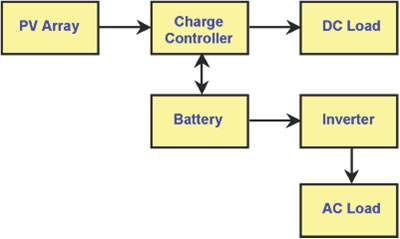
Figure 5. Direct-coupled PV system. In many stand-alone PV systems, batteries are used for energy storage. Figure 6 shows a diagram of a typical stand-alone PV system powering DC and AC loads. Figure 7 shows how a typical PV hybrid system might be configured.
Figure 6. Diagram of stand-alone PV system with battery storage powering DC and AC loads.
Figure 7. Diagram of photovoltaic hybrid system. How PV Cells Are Made The process of fabricating conventional single- and polycrystalline silicon PV cells begins very pure semiconductor-grade polysilicon - a material processed from quartz and used extensively throughout the electronics industry. The polysilicon is then heated to melting temperature, and trace amounts of boron are added to the melt to create a P-type semiconductor material. Next, an in got, or block of silicon is formed, commonly using one of two methods: 1) by growing a pure crystalline silicon ingot from a seed crystal drawn from the molten polysilicon or 2) by casting the molten polysilicon in a block, creating a polycrystalline silicon material. Individual wafers are then sliced from the ingots using wire saws and then subjected to a surface etching process. After the wafers are cleaned, they are placed in a phosphorus diffusion furnace, creating a thin N-type semiconductor layer around the entire outer surface of the cell. Next, an anti-reflective coating is applied to the top surface of the cell, and electrical contacts are imprinted on the top (negative) surface of the cell. An aluminized conductive material is deposited on the back (positive) surface of each cell, restoring the P-type properties of the back surface by displacing the diffused phosphorus layer. Each cell is then electrically tested, sorted based on current output, and electrically connected to other cells to form cell circuits for assembly in PV modules. Thin-Film Photovoltaics Thin-film photovoltaic modules are manufactured by depositing ultra-thin layers of semiconductor material on a glass or thin stainless-steel substrate in a vacuum chamber. A laser scribing process is used to separate and weld the electrical connections between individual cells in a module. Thin-film photovoltaic materials offer great promise for reducing the materials requirements and manufacturing costs for PV modules and systems. Pros and Cons of PV Photovoltaic systems have a number of merits and unique advantages over conventional power-generating technologies. PV systems can be designed for a variety of applications and operational requirements, and can be used for either centralized or distributed power generation. PV systems have no moving parts, are modular, easily expandable and even transportable in some cases. Energy independence and environmental compatibility are two attractive features of PV systems. The fuel (sunlight) is free, and no noise or pollution is created from operating PV systems. In general, PV systems that are well designed and properly installed require minimal maintenance and have long service lifetimes. At present, the high cost of PV modules and equipment (as compared to conventional energy sources) is the primary limiting factor for the technology. Consequently, the economic value of PV systems is realized over many years. In some cases, the surface area requirements for PV arrays may be a limiting factor. Due to the diffuse nature of sunlight and the existing sunlight to electrical energy conversion efficiencies of photovoltaic devices, surface area requirements for PV array installations are on the order of 8 to 12 m^2 (86 to 129 ft^2) per kilowatt of installed peak array capacity.
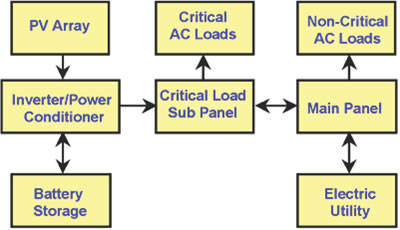
Figure 8. Diagram of grid-connected critical power supply system |


|
Buynigeriaonline.com |
| |
Service | | |
Jobs | | |
Contact us | | |
About us | | |
Faq |
