 |
 |
 |
|
 |
|
Buynigeriaonline.com |
| |
Home | | |
Contact us | | |
About us | | |
Trade Leads | | |
Services | | |
Faq |
|
|
BATTERIES Batteries are a key component in a grid-tie with back-up or a stand-alone renewable energy system that all of the other components rely on for operation. Without proper maintenance, batteries can fail prematurely and shut the whole system down. However, toiling over your battery bank with a voltmeter, hydrometer and a gallon of distilled water every day is not necessary. With simple monthly and quarterly maintenance procedures, your batteries should last for a long time. On the other hand, neglecting your batteries can drastically shorten their life span. The following statement sums it up best, "few batteries die a natural death, most are murdered". The following information is designed to tell you how to get the longest life and best performance possible from your battery bank. Most of this information is for flooded cell lead-acid batteries; alkaline (Ni-FE & Ni-Cad) and sealed gel-cell battery charging characteristics are completely different. Types Used in Solar Systems: There are three types of batteries that are most popularly used in solar electric systems. Each type has its pluses and minuses, so we will also include the systems the individual types are best suited for. Flooded Lead Acid: Flooded lead acid batteries have the longest track record in solar electric use and are still used in the majority of stand-alone solar systems. They have the longest life and the least cost per amp-hour of any of the choices. However the other side of the coin is, in order to enjoy these advantages, they require regular maintenance in the form of watering, equalizing charges and keeping the top and terminals clean. Some examples of flooded lead-acid batteries used in solar electric systems are 6 volt golf-cart batteries, 6 volt L-16's and 2 volt industrial cells for large systems. Absorbed Glass Mat Sealed Lead Acid (AGM): AGM batteries are seeing more and more use in solar electric systems as their price comes down and as more systems are getting installed that need to be maintenance free. This makes them ideally suited for use in grid-tied solar systems with battery back-up. Because they are completely sealed they can't be spilled, do not need periodic watering, and emit no corrosive fumes, the electrolyte will not stratify and no equalization charging is required. AGM's are also well suited to systems that get infrequent use as they typically have less than a 2% self discharge rate during transport and storage. They can also be transported easily and safely by air. Last, but not least, they can be mounted on their side or end and are extremely vibration resistant. AGM's come in most popular battery sizes and are even available in large 2 volt cells for the ultimate in low maintenance large system storage. When first introduced, because of their high cost, AGM's were mostly used in commercial installations where maintenance was impossible or more expensive than the price of the batteries. Now that the cost is coming down they are seeing use in all types of solar systems as some of today's owners think the advantages outweigh the price difference and maintenance requirements of flooded lead acid batteries. Gelled Electrolyte Sealed Lead Acid: Gelled lead acid batteries actually predated the AGM type but are losing market share to the AGM's. They have many of the same advantages over flooded lead acid batteries including ease of transportation, as the AGM type, except the gelled electrolyte in these batteries is highly viscous and recombination of the gases generated while charging, occurs at a much slower rate. This means that they typically have to be charged slower than either flooded lead acid or AGM batteries. In a solar electric system you have a fixed amount of sun hours every day and need to store every solar watt you can before the sun goes down. If charged at too high a rate, gas pockets form on the plates and force the gelled electrolyte away from the plates, decreasing the capacity until the gas finds its way to the top of the battery and is recombined with the electrolyte. For use in a grid-tie with back up system or any system where discharge rates are less than severe, gel batteries could be a good choice. Think of your batteries like a bucket of energy: Batteries are simply a storage vessel for the direct current (DC) power produced from your charging sources (solar modules, wind generator, micro-hydro or generator/battery charger). If you aren't familiar with the water to electricity analogy, please read the Basics of Electricity section. If you don't have time to read that whole section, then just remember that pressure = voltage and flow rate = amperage. The size of the bucket determines how much water it will hold which is analogous to the amp-hour storage capacity of a battery (bigger, heavier batteries hold more energy like a larger bucket holds more water). If you connected a pressure gauge to the bottom of a bucket and started filling it with water you would see the pressure increase until the water reaches the top. The same holds true for a battery as you put amperage or current into it, the voltage level rises. Deep Cycle vs. Shallow Cycle In battery lingo, a cycle on your battery bank occurs when you
discharge your battery and then charge it back up to the same level.
A lead acid battery is designed to absorb and give up electricity
by a reversible electrochemical reaction.
Warm in the winter, Cool in the summer The speed of the charging and discharging chemical reactions occurring inside a lead-acid battery is governed by temperature and charge/discharge current. The colder the temperature the slower the reactions and conversely the warmer the temperature the faster the reactions. Hence a cold battery will deliver less amperage in any given time frame as compared to a warm battery. Most of us have experienced this effect when trying to start our cars on a cold morning; the engine just doesn't turn over as quickly if at all. Warm that same battery up and you will see a major improvement. (See the bar graph of temperature effects below). The optimum temperature for a lead-acid battery is around 77°F, but 60-80°F is acceptable. For this reason we like to see batteries placed indoors or in a heated and ventilated space to maintain them between 60° to 80°F. If you do install them in an unheated space, battery capacity must be increased to compensate for this derating. On the other extreme, high temperatures (110°F+) can drastically shorten the life of the battery and should be avoided as well. Batteries aren't 100% efficient Energy is never consumed or produced, it merely changes form. The efficiency of conversion is never 100% and in the case of new batteries averages around 90%. This means that if you want to discharge 100 watt-hours of energy from a battery you must charge it with approximately 110 watt-hours of energy. Due to impurities in the chemicals used for battery construction, batteries will lose power to local action, an internal reaction which occurs whether you are using the battery or not. This slow discharging is termed self-discharge and its rates vary greatly among battery types and increases along with temperature. The rate also increases with the age of a battery, so much so that an old battery may require significant amount of charging just to stay even. Even new batteries may lose 1 to 2% of charge per day. Lead calcium grid batteries have the lowest self-discharge rates, but are not designed for deep cycling applications. Determining battery state of charge Battery state of charge is determined by reading the static (i.e.
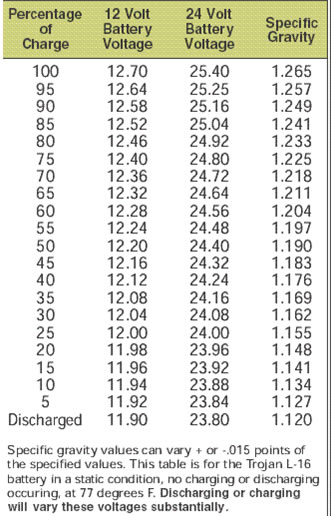
not charging or discharging) battery voltage or the specific gravity
of the electrolyte. The density or specific gravity of the sulfuric
acid (H2SO4) electrolyte of a lead-acid battery varies with the
state of charge and temperature. The density is lower when the battery
is discharged and higher as the cells are charged, (see the table
below). This is because the electrolyte is part of the chemical
reaction, it changes as the chemical reaction takes place. Specific
gravity is read with a hydrometer which will tell the exact state
of charge. A hydrometer cannot be used with sealed or gel-cell batteries.
These variations may seem hard to track, but in reality they are
not. A good accurate digital meter with a tenth of a volt accuracy
can be used with success. The pushing and pulling of voltage, once
accounted for by experience, can also help indicate the amount of
charging or discharging that is taking place. Monitoring battery state of charge is the single largest responsibility of the system owner. The battery voltage should be kept at or above a 50% state of charge at all times for maximum battery life (see the battery voltage table). Be sure to keep the battery's electrolyte level at the marked full level and never let the plates become exposed to the air. When refilling the batteries, use only distilled water - not tap water. Water is the only element used by your battery, you should never have to add additional acid to your battery. Do not over-fill the batteries or fill when the batteries are discharged. Over-watering dilutes the acid excessively and electrolyte will be expelled when charging.
Battery Gassing: As batteries are charged they create bubbles of gas, produced when the chemical reaction cannot keep up with the energy input. Some gassing is necessary in flooded cell batteries. The amount and duration of gassing varies from one battery to another. Gassing mixes the electrolyte and compensates for the tendency of the electrolyte to stratify with the more dense acid on the bottom. Gassing is the product of splitting water molecules into hydrogen and oxygen. This consumes water and creates the need for its periodic replacement. Corrosion: A slight acid mist is formed as the electrolyte bubbles upon charging. This mist is highly corrosive, especially to the metallic connectors on the tops of the batteries. Inspect for corrosion and carefully clean these periodically as needed with baking soda and water. Be sure not to get any baking soda into the battery electrolyte as it will have a neutralizing effect. Corrosion buildup can create a good deal of electrical resistance, which can contribute to shortened battery life and the waste of power. It's always a good idea to wear goggles and protective gear (goggles, rubber gloves and apron) when working on your batteries as the sulfuric acid can seriously damage your eyes and eat holes in your clothes. Equalization (EQ): Equalization is a controlled overcharging of a fully charged battery. This overcharge mixes the electrolyte, evens the charge among varying battery cells and reduces permanent sulfation of the battery plates. It is energy invested in lengthening the life of the battery. Though the PV system battery bank receives a good deal of cycling and gassing through normal activity, equalization is a complement to this activity and as a rule of thumb should be done every 60 to 90 days. The equalization process consumes water and produces much gassing, so your batteries should be well ventilated during this charging. Equalization charging voltages vary widely, as do duration times, so the batteries should be monitored closely during this process. Check periodically during the EQ process. You don't have to check every cell each time, but watch any that show a high variation from the rest of the cells. Keep checking the specific gravity of the electrolyte until you receive three readings of 30 minutes apart which indicate no further increase of specific gravity values. Keep a record of individual cell voltages and specific gravity before and after equalizing. Equalization will take your voltage to 15 volts or higher (30 volts on a 24 volt system) so make sure any DC loads are disconnected before you begin. Battery Connections: The connections from battery to battery and on to the charging and load circuits are critical. Before connecting your batteries together, be sure that the interconnects and battery terminals are clean. When making your series and parallel battery connections, be careful not to torque the connecting hardware too tight as the battery's lead posts can break easily. After all battery connections are made, go back to each battery terminal and apply anti-corrosion coating or grease to minimize corrosion build up. Torquing all bolts equally avoids variations in resistance. This variation in resistance is the main reason we prefer to minimize the number of parallel strings in the bank. Higher resistance values on one string of batteries result in less charge to that string and consequently shorter life. We also place the main negative and positive on opposing corners of the battery bank. The goal is to keep the variation of resistance from one parallel string to another to a minimum. Used Batteries: Like most things, you get what you pay for. Used lead acid batteries, especially large two volt telephone type cells can be found for sale at some very attractive prices. While used solar modules and inverters are usually an acceptable risk, used batteries are not. Should you consider them? In our experience it is difficult to know just how an older battery has been used and cared for. Our recommendation on used batteries is to inspect them carefully in person, get as much information as you can on them (manufacturer, age, amp-hour capacity and type of system they were used in) and have them load tested. Without load testing used batteries you are really guessing as to their remaining life. If you are considering telephone cells, realize that they are normally shallow cycle lead calcium grid construction, and should not be used in a system designed for deep cycling. DON'T SKIMP ON BATTERIES! A correctly sized battery bank is vital to the proper functioning of your system. Compromising on the battery bank can lead to poor performance and dissatisfaction with the entire system. Do not skimp here. |

|
Buynigeriaonline.com |
| |
Service | | |
Jobs | | |
Contact us | | |
About us | | |
Faq |
