 |
 |
 |
|
 |
|
Buynigeriaonline.com |
| |
Home | | |
Contact us | | |
About us | | |
Trade Leads | | |
Services | | |
Faq |
|
|
MODULES
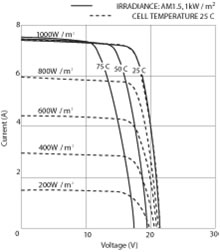
Solar Electric Modules Solar Modules Power Characteristics: The current and power output of photovoltaic modules are approximately proportional to sunlight intensity. At a given intensity, a module's output current and operating voltage are determined by the characteristics of the load. If that load is a battery, the battery's internal resistance will dictate the module's operating voltage. A module which is rated at 17 volts will put out less than its rated power when used in a battery system. This is because the working voltage will be between 12 and 15 volts. As wattage (power) is the product of volts times amps, the module output will be reduced. For example: a 50 watt module working at 13.0 volts will produce 39.0 watts (13.0 volts x 3.0 amps = 39.0 watts). This is important to remember when sizing a PV system. An I-V curve as illustrated to the right is simply all of a module's possible operating points, (voltage/current combinations) at a given cell temperature and light intensity. Increases in cell temperature increase current slightly, but drastically decrease voltage. Maximum power is derived at the knee of the curve. Check the amperage generated by the solar array at your battery's present operating voltage to better calculate the actual power developed at your voltages and temperatures. Shading: PV modules are very sensitive to shading. Unlike a solar thermal panel which can tolerate some shading, many brands of PV modules cannot even be shaded by the branch of a leafless tree. Shading obstructions can be defined as soft or hard sources. If a tree branch, roof vent, chimney or other item is shading from a distance, the shadow is diffuse or dispersed. These soft sources significantly reduce the amount of light reaching the cell(s) of a module. Hard sources are defined as those that stop light from reaching the cell(s), such as a blanket, tree
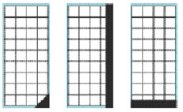
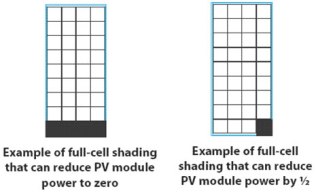
Partial-shading even one cell of a 36-cell module, will reduce its power output. Because all cells are connected in a series string, the weakest cell will bring the others down to its reduced power level. Therefore, whether ½ of one cell is shaded, or ½ a row os f cells is shaded as shown above, the power decrease willbe the same and proportional to the percentage of area shaded, in this case 50%. When a full cell is shaded, it can act as a consumer of energy produced by the remainder of the cells, and trigger the module to protect itself .The module will route the power around that series string. If even one full cell in a series string is shaded, as seen on the right, it will likely cause the module to reduce its power level to ½ of its full available value. If a row of cells at the bottom of a module is fully shaded the power output may drop to zero. The best way to avoid a drop in output power is to avoid shading whenever possible. Tilt Angle: To capture the maximum amount of solar radiation over a year, the solar array should be tilted at an angle approximately equal to a site's latitude, and facing within 15º of due south. To optimize winter performance, the solar array can be tilted 15º more than the latitude angle, and to optimize summer performance, 15º less than the latitude angle. At any given instant, the array will output maximum available power when pointed directly at the sun. To compare the energy output of your array to the optimum value, you will need to know the site's latitude, and the actual tilt angle of your array-which may be the slope of your roof if your array is flush-mounted. If your solar array tilt is within 15º of the latitude angle, you can expect a reduction of 5% or less in your system's annual energy production. If your solar array tilt is greater than 15º off the latitude angle, the reduction in your system's annual energy production may fall by as much as 15% from its peak available value. During winter months at higher latitudes, the reduction will be greater. Azimuth Angle and Magnetic Declination: If a south-facing roof is unavailable, or the total solar array is larger than the area of a south-facing roof section, an east or west-facing surface is the next best option. Be aware that solar power output decreases proportionally with a horizontal angle, or "azimuth," greater than 15º from due south. The decrease in annual power output from a latitude-tilted east or west-facing array may be as much as 15% or more in the lower latitudes or as much as 25% or more in the higher latitudes of the United States. Avoid directing your tilted solar panels northwest, north or northeast, as you'll get little power output. |

|
Buynigeriaonline.com |
| |
Service | | |
Jobs | | |
Contact us | | |
About us | | |
Faq |
